

Wondering how much time is left until noon? Whether you’re counting down to lunch, waiting for an important meeting, or racing to finish your morning tasks, every minute matters. Knowing exactly how much time remains can help you stay organized and make the most of your morning.
How Long Until 12 PM depends on your current local time. At 10:00 AM, you have two hours left, while at 11:30 AM, noon is just 30 minutes away. The good news is that calculating the time until noon is simple. You can find the remaining hours, minutes, and even seconds with a quick calculation. This guide shows you how to calculate the countdown, understand time zone differences, and manage your schedule more effectively. Whether you need a quick answer or help planning your day, you’ll find it here.
Time Remaining Until 12:00 PM
The time remaining until 12:00 PM tells you how long you must wait for noon. It changes every minute as your local clock moves forward.
A noon countdown timer can display the exact time left until midday. You can use an online countdown tool instead of calculating the time manually.
For example, if your current time is 10:20 AM, you have 1 hour and 40 minutes until noon. At 11:45 AM, just 15 minutes remain.
- Current time: Your local clock time right now.
- Target time: 12:00 PM, or noon.
- Time remaining: The hours, minutes, and seconds until the target.
A countdown reaches zero at noon. If noon has already passed, the next target is usually tomorrow’s noon.
Understanding How Long Until 12:00 PM
Understanding how long until 12:00 PM starts with knowing what noon means and how to measure the remaining time. The calculation is simple once you identify your current time.
Noon marks the middle of the daytime clock cycle. It separates morning hours from afternoon hours on a standard 12-hour clock.
You can use a digital clock, a standard clock, or a time remaining calculator. Each method helps you find the time difference between now and your target time.
What Time Is 12:00 PM?
12:00 PM means noon, the point when the morning ends and the afternoon begins. It appears as 12:00 on a 12-hour clock and 12:00 in the 24-hour time format.
The hour hand points to 12 on an analog clock. The minute hand also points to 12 because the minutes have reached zero.
It’s important to distinguish noon from midnight. 12:00 AM means midnight, which marks the beginning of a new calendar day.
For example, imagine someone asks, “Will we meet at 12 PM or 12 AM?”
You should confirm the time before making plans. Noon means lunchtime, while midnight means the middle of the night.
How to Calculate How Long Until 12 PM?
You can calculate time until noon by subtracting the current time from 12:00 PM. This basic time calculation works well when noon hasn’t arrived yet.
First, check your local clock. Next, determine how many hours and minutes remain before the clock reaches noon.
For example, suppose it’s 8:40 AM. From 8:40 AM to 9:00 AM, you have 20 minutes. From 9:00 AM to noon, you have another 3 hours.
Your total is 3 hours and 20 minutes.
Follow these steps:
- Check the current time.
- Set 12:00 PM as your target time.
- Calculate the remaining hours and minutes.
- Add the intervals to find the total duration.
If noon has passed, calculate the time until tomorrow’s noon instead.
Examples of How Long Until 12:00 PM
Simple examples make the countdown to noon easier to understand. The remaining time depends on the exact time shown on your clock.
Consider these common morning times. Each example shows how much time remains before 12:00 PM.
| Current time | Time until noon |
| 5:30 AM | 6 hours and 30 minutes |
| 6:00 AM | 6 hours |
| 8:15 AM | 3 hours and 45 minutes |
| 8:40 AM | 3 hours and 20 minutes |
| 9:00 AM | 3 hours |
| 9:50 AM | 2 hours and 10 minutes |
| 10:20 AM | 1 hour and 40 minutes |
| 11:00 AM | 1 hour |
| 11:30 AM | 30 minutes |
| 11:45 AM | 15 minutes |
For instance, if someone asks, “How long until noon at 9:50 AM?” the answer is 2 hours and 10 minutes.
These examples also help you check your manual time calculation.
Read More: How Long Until 2:15? A Complete Time Calculator Guide
How Long Until 12 PM Today?
The answer to how long until 12 PM today depends on your current local time. Before noon, calculate the remaining hours and minutes until midday.
Suppose it’s 10:30 AM. You have 1 hour and 30 minutes until noon. If it’s 11:45 AM, you have just 15 minutes left.
However, the calculation changes after noon. If your clock shows 1:00 PM, today’s noon has already passed. You’ll need to wait 23 hours until the next noon.
Here are three quick examples:
- At 9:00 AM, noon arrives in 3 hours.
- At exactly 12:00 PM, the countdown reaches zero.
- At 1:00 PM, tomorrow’s noon is 23 hours away.
Always check your local time before calculating the countdown.
Why People Search How Long Until 12:00 PM
People search how long until 12:00 PM for many everyday reasons. Some want to know when lunch starts, while others need to finish work before a deadline.
A quick time calculation helps people manage their schedules and avoid last-minute stress. It can also make a busy morning feel easier to organize.
For example, a student may have an assignment due at noon. An office worker might need to finish a report before a midday meeting.
Knowing the time remaining until noon helps both people decide what to do first. A simple countdown can turn an uncertain morning into a manageable plan.
Planning Work and School Schedules
Noon often acts as a useful checkpoint in a work schedule or school day. People use it to organize tasks, track deadlines, and prepare for afternoon activities.
Suppose you start work at 8:00 AM and need to submit a report by noon. You have four hours to complete the task.
A student with a school assignment due at 11:30 AM has less time. Checking the current time helps them decide how quickly to work.
You can use the countdown to plan:
- Work meetings and project deadlines.
- School assignments and study sessions.
- Lunch breaks and scheduled calls.
- School pickups and other daily responsibilities.
A clear morning schedule helps you prioritize important tasks instead of guessing how much time remains.
Managing Morning Tasks
Morning tasks can pile up quickly when you don’t have a clear plan. Checking how long until noon helps you decide which activities deserve your attention first.
For example, you might need to answer emails, prepare breakfast, finish a report, and buy groceries. If it’s 9:00 AM, you have three hours before noon.
Try dividing your morning into smaller time blocks. Give each task a realistic deadline and leave a little room for unexpected delays.
A simple plan might look like this:
- 9:00 AM to 9:30 AM: Answer important emails.
- 9:30 AM to 10:30 AM: Finish your main task.
- 10:30 AM to 11:00 AM: Take a short break.
- 11:00 AM to noon: Review your work and prepare for lunch.
This approach supports better time management and reduces unnecessary pressure.
Tracking Appointments and Events
Appointments often depend on precise timing. A noon countdown helps you prepare for doctor’s appointments, work meetings, interviews, and other scheduled events.
Imagine you have an online appointment at 11:30 AM. At 10:45 AM, you have 45 minutes to gather documents, check your internet connection, and find a quiet place.
The same idea applies to deliveries, webinars, livestreams, and travel schedules. You can use a countdown to remember when an event begins.
However, don’t rely on the countdown alone for important travel plans. Check official flight departures, train departures, and bus departures for updated information.
A reminder app or calendar can also help you manage these time-sensitive tasks. Set an alert early enough to prepare without rushing.
Understanding How Long Until Noon
Noon is another name for 12:00 PM, or midday. When people ask how long until noon, they usually want to know the remaining time before the clock reaches twelve.
The calculation works the same way as any other time interval. Compare your current local time with the target time of 12:00 PM.
For example, at 11:15 AM, you have 45 minutes until noon. At 11:59 AM, you have one minute left.
You may also hear people use the word midday when discussing lunch plans or work schedules. In everyday conversation, both terms usually refer to noon.
Remember that noon differs from midnight. Noon occurs during the day, while midnight marks the transition between calendar days.
How Countdown Timers Help With Daily Planning
A countdown timer gives you a quick view of the time remaining until noon. Instead of repeatedly checking your clock, you can see how close you are to your target time.
An online countdown tool can display hours, minutes, and seconds. Some tools also update in real time as each second passes.
This can help you plan a morning schedule, prepare for a lunch break, or track a noon deadline. The key is to use the countdown as a guide rather than a reason to rush.
For example, a 12 PM countdown can remind you to wrap up a task before lunch. You can then move to your next activity with less confusion.
Get a Quick Answer Without Manual Calculation
Manual time calculation works well, but it can take extra effort when you’re busy. A time calculator tool gives you a faster way to calculate the time remaining.
Enter or check your current time and set noon as the target. The tool can calculate the time difference and show the remaining hours and minutes.
For example, if it’s 9:50 AM, you have 2 hours and 10 minutes until noon. An online countdown tool can display that result without requiring subtraction.
A useful tool should:
- Use the correct local time.
- Update the countdown accurately.
- Show hours, minutes, and seconds when needed.
- Handle the next day’s noon when midday has passed.
Always check your device’s clock settings. An incorrect local clock can produce an incorrect countdown.
Break the Morning Into Manageable Tasks
A noon countdown can help you divide a long morning into smaller tasks. Instead of thinking about everything you need to finish, focus on one activity at a time.
Suppose it’s 8:15 AM and you have several things to do before lunch. You have 3 hours and 45 minutes until noon.
You might spend the first hour on a major project, then use 30 minutes for emails. Afterward, reserve time for a meeting and a final review.
Try this simple method:
- List your most important morning tasks.
- Estimate how long each task will take.
- Assign a time block to each activity.
- Check your progress before noon.
This approach makes time blocking easier. It also helps you adjust your schedule when a task takes longer than expected.
Stay Focused on Important Deadlines
A visible countdown can remind you that a deadline is approaching. It helps you keep your attention on the work that matters most.
For example, imagine you must submit a project by noon. At 10:00 AM, you have two hours remaining.
Instead of checking the clock every few minutes, choose a clear milestone. Finish the main draft by 11:00 AM, review it by 11:30 AM, and submit it before the deadline.
The Pomodoro method may also help. Work in focused sessions with short breaks between them.
Remember that a countdown doesn’t replace good planning. Leave extra time for unexpected problems, especially when submitting important documents or completing time-sensitive tasks.
Use a Noon Countdown for Reminders
A noon countdown works well with reminder apps and calendar events. It can help you remember an upcoming appointment, lunch break, or scheduled task.
Suppose you have a meeting at 12:00 PM. You can set a reminder for 11:30 AM to review your notes and prepare any documents.
You might also use reminders for school assignments, medication schedules prescribed by a professional, or personal errands. Choose alert times that give you enough time to act.
Helpful reminder ideas include:
- Review your morning progress at 11:00 AM.
- Prepare for lunch at 11:30 AM.
- Finish urgent emails before noon.
- Check your afternoon calendar before the midday break.
A reminder app makes these tasks easier to manage. Use alerts that support your routine without overwhelming you with notifications.
Time Conversion: From AM and PM to 24-Hour Format
Time conversion helps you understand how the 12-hour clock relates to the 24-hour clock. This matters when reading digital schedules, travel itineraries, or international appointment details.
The 12-hour clock uses AM and PM to distinguish morning from afternoon and evening. The 24-hour clock uses numbers from 00:00 through 23:59.
For example, 2:00 PM becomes 14:00 in the 24-hour time format. Noon remains 12:00, while midnight appears as 00:00.
Understanding both formats helps you avoid mistakes when calculating the time until noon. It also makes schedule coordination easier across different systems.
What Does 12:00 PM Mean in 24-Hour Time?
In 24-hour time, 12:00 PM remains 12:00. It represents noon, the midday point when the morning transitions into the afternoon.
You don’t add 12 to noon because the hour is already 12. For afternoon times after 12 PM, you generally add 12 to the hour when converting to 24-hour time.
For example:
- 12:00 PM = 12:00.
- 1:00 PM = 13:00.
- 2:00 PM = 14:00.
- 6:00 PM = 18:00.
- 11:00 PM = 23:00.
Military time uses this same basic 24-hour system. Some organizations omit the colon, so 14:00 may appear as 1400.
The format varies, but the underlying time remains the same.
AM and PM Conversion Examples
AM and PM help you identify the part of the day associated with a time. AM covers the period after midnight and before noon, while PM covers the period after noon and before midnight.
The two exceptions need special attention. 12:00 AM is midnight, and 12:00 PM is noon.
Use this table to compare common times:
| 12-hour clock | 24-hour clock |
| 5:30 AM | 05:30 |
| 8:15 AM | 08:15 |
| 9:50 AM | 09:50 |
| 11:45 AM | 11:45 |
| 12:00 PM | 12:00 |
| 12:15 PM | 12:15 |
| 2:20 PM | 14:20 |
| 11:00 PM | 23:00 |
| 12:00 AM | 00:00 |
These examples make time conversion easier when reading digital clocks, schedules, and travel information.
Avoiding the 12 AM and 12 PM Confusion
Confusing 12 AM with 12 PM can cause missed appointments and scheduling mistakes. The simplest way to remember the difference is to associate noon with lunchtime and midnight with nighttime.
12 PM means noon.
12 AM means midnight.
For example, if a message says your appointment begins at 12 PM, you should expect it around midday. If it says 12 AM, the appointment begins at midnight.
When a schedule uses only numbers, check whether it follows the 12-hour or 24-hour clock. The 24-hour format removes AM and PM, which can reduce confusion.
For important events, confirm the date and time with the organizer. Clear communication matters when coordinating appointments, flights, meetings, or online events.
How Time Zones Affect the Noon Countdown
Time zones affect the countdown because noon occurs at different moments around the world. When it’s 12 PM in one location, another location may still be experiencing morning or evening.
Your local time zone determines the clock time used for the calculation. A noon countdown should therefore use your device’s correct time and location settings.
International time differences matter when arranging calls, online meetings, and scheduled events. Coordinated Universal Time (UTC) provides a common reference for comparing times around the world.
For example, noon in New York doesn’t happen at the same moment as noon in Los Angeles. Their local clocks follow different time zones.
Why How Long Until 12:00 PM Depends on Location
The answer to how long until 12:00 PM depends on the time displayed in your local time zone. Two people can check their clocks at the same moment and see different local times.
Suppose it’s 9:00 AM in one location and 10:00 AM in another. The first person has three hours until noon, while the second has two hours.
Both calculations are correct because each person uses a different local clock. The physical moment when noon arrives also differs between their locations.
When scheduling an international meeting, confirm the date, time zone, and UTC offset. This helps everyone join at the correct moment.
A time zone conversion tool can make this process easier, especially when participants live in different countries.
Common U.S. Time Zones
The United States uses several time zones, including Eastern Time (ET), Central Time (CT), Mountain Time (MT), and Pacific Time (PT). These zones generally differ by one hour between neighboring regions.
When noon arrives in the Eastern Time zone, it is generally 11:00 AM Central, 10:00 AM Mountain, and 9:00 AM Pacific. These examples describe the usual relationship when all regions follow the same seasonal clock rules.
| Time zone | Usual relationship when Eastern Time is noon |
| Eastern Time (ET) | 12:00 PM |
| Central Time (CT) | 11:00 AM |
| Mountain Time (MT) | 10:00 AM |
| Pacific Time (PT) | 9:00 AM |
Eastern Standard Time, Central Standard Time, Mountain Standard Time, and Pacific Standard Time refer to standard-time periods. Daylight periods use different abbreviations in many locations.
Always check the date and location before calculating a cross-country countdown.
Daylight Saving Time and Noon
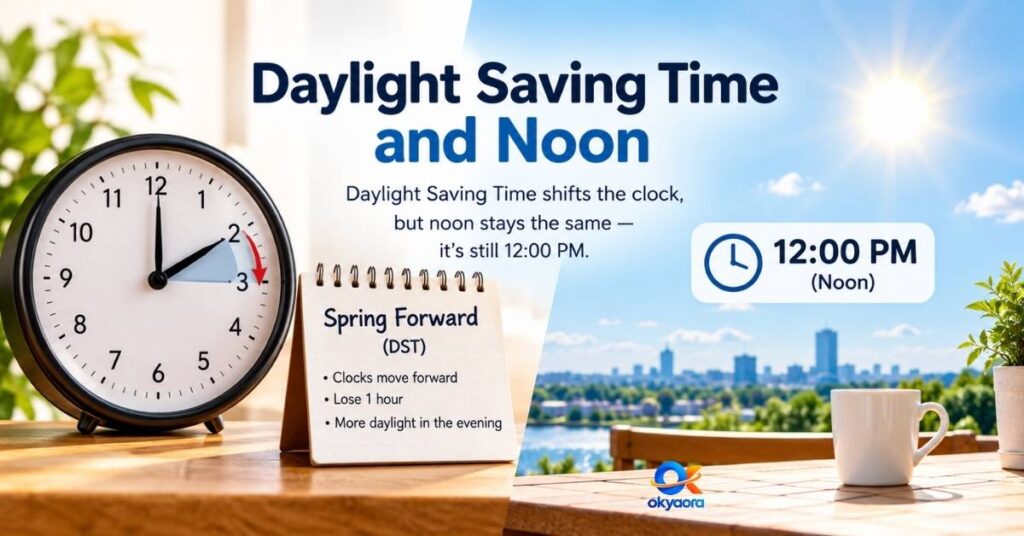
Daylight Saving Time (DST) changes local clock settings in places that observe it. Many participating regions move clocks forward in spring and move them back in fall.
These changes affect the relationship between local time and Coordinated Universal Time (UTC). They can also change the time difference between two locations.
However, daylight saving time doesn’t change the meaning of noon. 12:00 PM remains noon on the local clock.
The main issue appears when you compare locations or calculate a countdown across a clock change. A time interval may differ from what you expect if the clocks move forward or backward during that interval.
For an ordinary same-day countdown to noon, use the current local clock. For international scheduling, verify the time zone rules for the specific date.
Why Your Countdown May Differ From Someone Else’s
Your countdown may differ from someone else’s because you use different local times or target different time zones. Device settings can also affect the result.
For example, imagine you’re in a location where it’s 10:00 AM. You have two hours until local noon.
A friend in another time zone may see 11:00 AM and have only one hour left until their own noon. Neither countdown is wrong.
Other possible causes include:
- An incorrect device clock.
- An outdated time zone setting.
- A different target date.
- Daylight Saving Time changes.
- A countdown set to another location.
Before comparing results, make sure both people use the same target time and date. Accurate settings help keep the calculation consistent.
Creative Ways to Use a Noon Countdown
A noon countdown can do more than show the time remaining until lunch. It can also help you build routines, set short-term goals, and organize daily activities.
For example, you might use noon as a checkpoint for completing a project or reviewing your morning schedule. A countdown makes that target easy to see.
You can also use it for fitness goals, meal planning, family activities, and personal errands. The aim isn’t to fill every minute with work.
Instead, use the countdown to make your morning more intentional. Leave room for breaks and unexpected changes.
Create a Morning Productivity Challenge
A morning productivity challenge gives you a clear target before noon. Choose a few useful tasks and decide which ones you want to finish by midday.
For example, you might aim to complete a report, clear urgent emails, and tidy your workspace before lunch. If it’s 8:30 AM, you have 3 hours and 30 minutes.
Keep your goals realistic. A short list of important tasks usually works better than a long list that leaves no time for breaks.
Try this simple challenge:
- Choose three priority tasks.
- Set a reasonable time limit for each.
- Check your progress halfway through the morning.
- Review what you completed at noon.
This approach can improve focus and concentration without turning your morning into a race against the clock.
Plan a Lunch Break
A countdown to noon can help you prepare for lunch without interrupting important work. You can use the remaining time to finish a task, prepare a meal, or arrange a lunch meeting.
Suppose it’s 11:00 AM and your lunch break starts at noon. You have one hour left to complete your current task and save your work.
If you bring lunch from home, you can use part of the morning for meal planning. If you plan to meet someone, confirm the location and travel time before your break begins.
A simple plan might include:
- Finish your current task by 11:40 AM.
- Save your work and check messages.
- Take your lunch break at noon.
Planning ahead helps you enjoy your break without leaving unfinished tasks scattered across your desk.
Set a Midday Fitness Goal
Noon can serve as a useful target for a short fitness activity. You might plan a morning workout, a brisk walk, or a few stretching exercises before lunch.
For example, if it’s 10:30 AM, you have 90 minutes until noon. You could schedule a 20-minute walk and still leave time for your other responsibilities.
Choose an activity that fits your routine and physical comfort. You don’t need a demanding workout to benefit from a short movement break.
Consider these simple ideas:
- Take a short walk before lunch.
- Stretch between work sessions.
- Complete a brief home workout.
- Prepare your equipment before the planned activity.
A countdown helps you reserve time for movement. It also reminds you to balance work with personal well-being.
Use Noon as a Daily Checkpoint
Noon provides a natural point to review your morning progress. You can check completed tasks, identify unfinished work, and adjust your afternoon schedule.
Suppose you planned to finish four tasks before lunch but completed only three. Instead of rushing through the last one, decide whether it needs immediate attention or can wait.
A daily checkpoint also helps you notice patterns. You may discover that certain tasks consistently take longer than expected.
Ask yourself three questions at noon:
- What did I complete this morning?
- Which tasks still need attention?
- What should I prioritize this afternoon?
This small habit supports time management and better planning. Over time, it can help you create a schedule that reflects your actual workload.
Plan Family, School, or Personal Activities
A noon countdown can help coordinate family plans, school pickups, errands, and personal activities. When several people share a schedule, clear timing reduces confusion.
For example, a parent might use the morning to finish household tasks before collecting a child from school. Someone working from home might schedule errands before a midday appointment.
The key is to account for travel and preparation time. If an activity starts at noon, don’t assume you can begin preparing at 11:59 AM.
Use a calendar or reminder app to organize scheduled events. Add alerts when you need time to travel or gather supplies.
A little planning can make the morning smoother for everyone. It also leaves more room for unexpected changes.
How to Calculate the Time Until 12:00 PM Manually
You don’t need a special tool to calculate the time until noon. A clock and a basic understanding of hours and minutes are enough for most everyday situations.
First, identify your current time and your target time. Then calculate the time difference between them.
If the current time is before noon, subtract it from 12:00 PM. If it’s already noon, no time remains until that moment.
After noon, you’ll usually calculate the duration until the next day’s noon. This distinction prevents mistakes when someone asks how long until 12 PM today.
If It Is Before Noon
When it’s before noon, subtract the current time from 12:00 PM. You can count forward to the next hour and then continue until noon.
For example, if it’s 9:50 AM, count ten minutes to 10:00 AM. Then add two hours to reach noon.
The total is 2 hours and 10 minutes.
For another example, at 11:30 AM, you have 30 minutes left. At 6:00 AM, you have six hours remaining.
Use this simple method:
- Check the current hour and minute.
- Count to the next full hour if needed.
- Add the remaining full hours.
- Include any final minutes.
This method works well for everyday time arithmetic. It also lets you verify the results shown by an online countdown tool.
If It Is Exactly Noon
If your clock shows exactly 12:00 PM, the time remaining until noon is zero. The target time has arrived, so there’s no additional waiting time.
For example, suppose you set a reminder for noon. When the clock reaches 12:00 PM, your countdown reaches zero and the reminder should be due.
One minute later, the clock reads 12:01 PM. Today’s noon has passed, so the next occurrence is tomorrow at noon.
This distinction matters when calculating a countdown automatically. A tool should recognize whether the target time has arrived or passed.
Remember that noon and midnight are different points in the day. At 12:00 PM, it’s midday; at 12:00 AM, a new calendar day begins.
If It Is After Noon
If it’s after noon, today’s 12 PM has already passed. To calculate the time until the next noon, count forward to 12:00 PM tomorrow.
For example, if it’s 1:00 PM, you have 11 hours until midnight. Another 12 hours brings you to tomorrow’s noon.
That makes a total of 23 hours.
Here’s another example. At 4:00 PM, you have eight hours until midnight and another 12 hours until noon. The total is 20 hours.
Keep these examples in mind:
- 12:15 PM: 23 hours and 45 minutes until tomorrow’s noon.
- 6:00 PM: 18 hours until tomorrow’s noon.
- 11:00 PM: 13 hours until tomorrow’s noon.
These calculations assume ordinary local clock time without a clock change during the interval.
Quick Examples: How Long Until 12 PM?
Quick examples make it easier to calculate the time remaining until noon in different situations. The exact answer depends on your current time, target time, and time zone.
If you’re checking a countdown, use your local clock as the starting point. For a target in another time zone, convert the target time first.
The examples below explain how to calculate seconds and minutes until noon, how to handle other target times, and how to compare noon across US time zones.
How Many Seconds Until 12 PM Today?
The number of seconds until 12 PM today depends on the current time. To calculate it, find the remaining hours, convert them into seconds, and add any remaining seconds.
One hour contains 3,600 seconds. One minute contains 60 seconds.
For example, if it’s 11:59 AM exactly, you have one minute until noon. That’s 60 seconds.
If it’s 11:30 AM exactly, you have 30 minutes remaining. Multiply 30 by 60 to get 1,800 seconds.
Use this formula:
Seconds remaining = hours remaining × 3,600 + minutes remaining × 60 + remaining seconds.
A real-time countdown can update this result every second. For accurate results, make sure your device clock matches the correct local time.
How Many Minutes Till 12 PM?
The number of minutes until 12 PM depends on how far away noon is from your current time. Multiply the remaining hours by 60, then add the remaining minutes.
For example, if it’s 10:30 AM, you have 90 minutes until noon. At 11:45 AM, you have only 15 minutes remaining.
Here’s a quick reference:
| Current time | Minutes until noon |
| 9:00 AM | 180 minutes |
| 10:00 AM | 120 minutes |
| 10:30 AM | 90 minutes |
| 11:00 AM | 60 minutes |
| 11:30 AM | 30 minutes |
| 11:45 AM | 15 minutes |
| 11:59 AM | 1 minute |
If noon has already passed, calculate the minutes until tomorrow’s noon instead.
How Much Time Until 12:30 AM Today?
12:30 AM occurs 30 minutes after midnight. It is not the same as 12:30 PM, which occurs around lunchtime.
To calculate how much time remains until 12:30 AM, compare the current time with that target. If it’s 11:00 PM, you have 1 hour and 30 minutes until 12:30 AM.
If it’s 10:00 PM, you have 2 hours and 30 minutes remaining. However, if it’s already 1:00 AM, today’s 12:30 AM has passed.
In that case, the next occurrence is tomorrow at 12:30 AM.
Always check whether your target falls later today or has already passed. That small step prevents a common mistake in countdown calculations.
How Long Until 12 PM EST?
The time until 12 PM Eastern Standard Time (EST) depends on your current time and location. EST is UTC−5 and applies during standard time in locations that use it.
During daylight saving time, many of those locations switch to Eastern Daylight Time (EDT), which is UTC−4. For that reason, the phrase “12 PM Eastern Time” can be more appropriate when you mean local Eastern time throughout the year.
To calculate the countdown, identify the target date and confirm whether Eastern Standard Time or Eastern Daylight Time applies. Then compare that target with your current time.
For example, if it is 10:00 AM EST in the same location, noon EST is two hours away. If you’re elsewhere, convert the target to your own time zone first.
How Long Until 12 PM Central Time?
The time until 12 PM Central Time depends on the current clock and the date. Central Standard Time (CST) uses UTC−6, while Central Daylight Time (CDT) uses UTC−5.
If it’s 10:00 AM Central Time, you have two hours until local noon. At 11:30 AM Central Time, you have 30 minutes remaining.
If you’re in another time zone, the calculation may be different. For example, noon Central Time usually occurs one hour after noon Eastern Time’s equivalent clock offset? No. More precisely, 12 PM Central Time occurs one hour after 12 PM Eastern Time when both regions follow their usual synchronized seasonal clock rules.
Check the target date before scheduling an international meeting. Daylight Saving Time can affect the UTC offset and the relationship between locations.
How Long Until 12 PM PST?
Pacific Standard Time (PST) uses UTC−8. However, many locations in the Pacific time zone switch to Pacific Daylight Time (PDT), which uses UTC−7, during daylight saving time.
If it’s 9:00 AM PST, you have three hours until noon PST. At 11:15 AM PST, only 45 minutes remain.
If you live outside the Pacific time zone, convert noon Pacific time to your local time before calculating the countdown. The answer may change depending on the date and whether daylight saving time applies.
For meetings, travel, or online events, check the time zone abbreviation carefully. A schedule that says “12 PM Pacific Time” may be clearer than one that specifies PST throughout the year.
FAQ’s
How long until 12 PM?
How Long Until 12 PM depends on your current local time. Subtract the current time from noon to calculate the remaining hours and minutes.
How many seconds until 12 PM today?
Multiply the remaining minutes by 60 to calculate seconds until noon. For example, one minute equals 60 seconds.
How many minutes till 12 PM?
Calculate the minutes remaining by multiplying the hours by 60, then adding extra minutes. At 11:30 AM, 30 minutes remain.
How much time until 12:30 AM today?
12:30 AM occurs thirty minutes after midnight. If it’s 11:00 PM, you have one hour and thirty minutes remaining.
How long until 12 PM EST?
Check the current Eastern Standard Time and subtract it from noon. Remember that Eastern locations may observe daylight saving time.
How long until 12 PM Central Time?
Compare the current Central Time with noon to calculate the countdown. At 11:00 AM Central Time, one hour remains.
How long until 12 PM PST?
Check the current Pacific Standard Time and calculate the difference until noon. At 10:00 AM PST, two hours remain.
Conclusion
Knowing how long until 12 PM helps you plan morning tasks, prepare for appointments, and manage your daily schedule. The calculation is simple: compare your current time with noon and find the remaining hours and minutes.
If it’s before noon, calculate the time left until 12:00 PM today. If noon has already passed, count toward tomorrow’s noon instead.
You can work out the time manually or use a noon countdown timer for real-time updates. Just make sure your device shows the correct local time and time zone.
Whether you’re planning a lunch break, tracking a deadline, or organizing a busy morning, a clear countdown helps you use your time wisely.